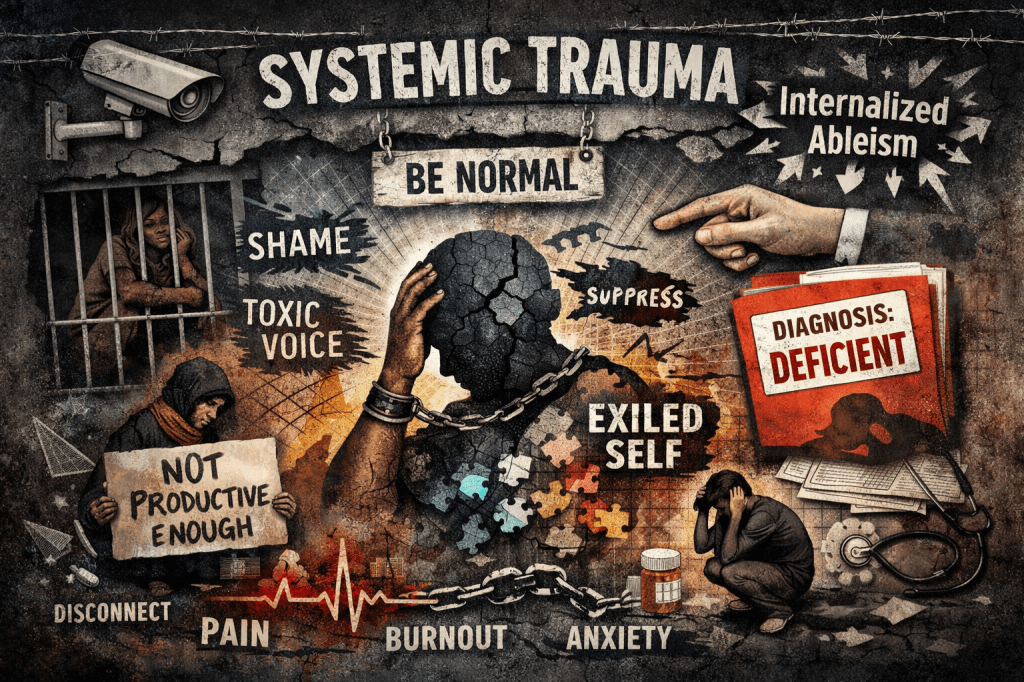
I am a neurodivergent therapist working with neurodivergent adults. My focus is not “coping better” in a hostile world, but developing positive self-identity and real agency in people who have been systematically taught to mistrust themselves.
I work in an explicitly anti-oppressive, systemic, and liberation psychology–informed way. That’s not branding. It’s a response to reality.
Because society does a real number on neurodivergent people.
What the World Does to Us
From early on, neurodivergent people are taught—explicitly and implicitly—to cut off from our own experience.
- We learn not to trust what our bodies tell us.
- We learn that discomfort is a personal failure, not a rational response.
- We learn shame before we learn language for what’s happening to us.
Our value is measured almost entirely through productivity, compliance, and legibility. We are assessed (and diagnosed) relentlessly for what we cannot do, while the effort it takes to survive is rendered invisible.
This isn’t abstract. It’s physical.
People come to me with stomach pain, migraines, tight chests, shallow breath, chronic exhaustion. Nervous systems that have been battered by years of being required to perform regulation in environments that actively prevent it. Yet society refuses to acknowledge this as harm. Instead, it individualises the distress and calls it anxiety, poor resilience, or a skills deficit.
Many neurodivergent adults live in chronic dysregulation not because they are “bad at regulating,” but because they are not allowed to be regulated.
The Cruellest Part: Internalisation
The real kicker is that none of this stays external.
We internalise it.
The messages become a voice inside: harsh, punitive, demanding, often brutal. Therapy culture often calls this the inner critic, but that phrase is frequently too soft, too polite, too psychological to capture what’s really going on.
What many neurodivergent people carry is internalised ableism—learned from families, schools, healthcare, workplaces, and the state—and then enforced from the inside.
You don’t need to be actively oppressed today for this to keep doing damage. The system trains us to perpetuate it ourselves.
How I Work: Parts, but Political
I do parts work. And I name something many models avoid saying plainly:
the part that gets exiled is very often the autistic part.
Not because autism is inherently shameful, but because the world makes it so.
This exile is not an intrapsychic accident. It is systemically produced.
When I work with parts, I am not trying to get people to manage or override their neurodivergence. I am working to undo the conditions that made it unsafe to inhabit themselves in the first place.
Intersectionality Is Not Optional
This work is always intersectional.
Blackness, class, gender, additional disability, migration status—these are not “extra layers.” They fundamentally shape who is punished, who is believed, who is pathologised, and who is offered care.
I name the system we are working inside as white supremacy.
Not because it’s fashionable, but because it is structurally accurate.
White supremacy is not only about race (though its violent and false construction of race is central). It also organises worth, normality, and humanity along a hierarchy. Disability—particularly cognitive and neurodevelopmental difference—moves you further from whiteness, further from protection, further from credibility.
There is nuance in who is permitted proximity to safety and who is not. Neurodivergent people feel this in our bones, whether or not it is ever named. Clients who are multiply marginalised by the structure feel this the deepest.
Why I Don’t Always Say This Out Loud
I don’t always speak this model publicly.
To often speaking in these terms gets an angry response and people stop listening.
This is because this work:
- destabilises the fantasy of therapeutic neutrality
- threatens professional innocence
- and relocates “the problem” from the client to the system
And because it asks a harder question than “how can this person cope better?”
It asks: what are we asking people to survive?
Putting the Problem Where It Belongs
Working systemically with neurodivergent clients means:
- identifying trauma that was produced socially, not just relationally
- dismantling internalised ableism
- rebuilding a sense of self that is accurate, not aspirational
- and restoring agency where compliance once passed for health
Autistic mental health outcomes are poor not because autistic people are broken, but because this is systemic trauma, and it shows up in both body and mind.
I do this work with my clients.
I do it with myself.
It is long work. The roots go deep.
But I am not interested in therapies that help people adjust to injustice and call it healing.
This is me.
If you’re with me, you probably already know why.
 Dr Stephanie Aspin